Anti Roll Bars
Anti-roll bars, otherwise known as drop links or stabiliser bars/links connect to the wheel suspension of an axle with the body structure of the car. It plays an important role in ensuring you have a safe and comfortable journey ☺
They comprise of two ball joints, one at each end and a bar, which is then mounted to the suspension struts or the control arms (otherwise known as wishbones), as many already know these parts are very prone to failure. Here’s an image below to help identify where it is located ☺
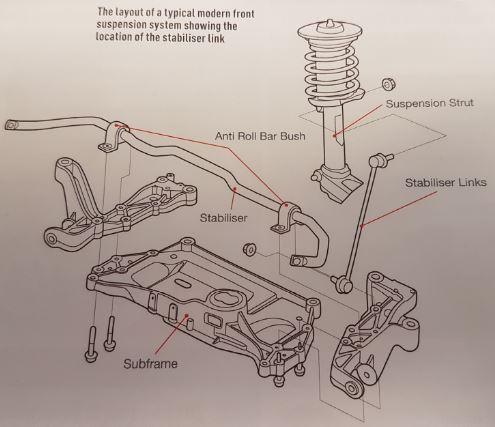
You will find that most vehicles only have them installed at the front axle, but some vehicles have them both on the front and rear axle as well!
When a wheel deflects, the torsion of the anti roll bar ensures that the other wheel is also raised and lowered on rebound. This prevents excessive rolling of the body of the car when cornering. If two wheels deflect simultaneously, the anti roll bar does not activate.
So, when do you know if you’ve got a problem?
If you’ve gone over a speed bump for example or uneven roads, you may hear a loud knocking noise which is a warning sign of failure or damage. The most common cause is worn bearings or defective ball joints on the anti roll bar link.
Worn bearings cause the stabiliser bar to rattle on deflection and rebound.
The good news is that it isn’t very costly to buy or replace an anti roll bar link, as it’s a pretty straight forward part to install ☺
It is highly recommended that if you do hear a knocking sound that you get it looked in to straight away, because if the bar snaps this can heighten the risk of uncontrolled rolling and overturning.
When replacing the link, you should always ensure that the correct torque is applied during installation. Failing to do this can damage the ball joint, causing premature wear and breakage ☹
When buying a anti roll bar link, it’s always advised that you buy them in pairs and replacing both, just like wishbone arms.
How do I know I’m buying the correct ones?
The first thing to check is the make, model and year of your car, to ensure that the title matches ☺
This may seem obvious but it can be easily missed. Err on the side of caution if your year is the earliest or latest year within the title, for example “Vauxhall Astra 1998-2004”. If you have a 1998 or 2004 model, you could potentially have the older (pre-facelift) model or newer (face-lift) model. If you are unsure about this, then please do send us your vehicle registration and we will be happy to confirm for you ☺
The next thing to check is any extra information we’ll have in the listing, such as if we list the length of the bar – If you can check this, this would be a sure fire way of ensuring that you’re getting the right thing. If you’ve gone to the effort to check this, then please also check the shape, because some vehicles can have a variant whereby the shape is different.
In nearly all cases however, if you’ve checked the make, model, year and all the information we’ve provided you with, you can buy with confidence ☺
If you want to go the extra mile and check our original part numbers against your own, this is the best way to ensure that you do have the correct part.
We hope this guide has been helpful! If you are still unsure then please send us a message along with your vehicle registration plate, our team are always happy to help you.